PTET, other legislative updates at the Minnesota Legislature
April 10, 2026 | Geno Fragnito
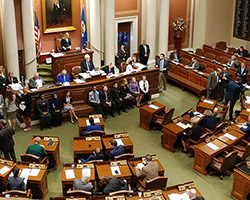
Deadlines are deadlines — unless they’re not.
While the strongly supported pass-through entity tax election extension was not advanced yet through the Minnesota House and Senate, hope remains that it will be approved this session.
The first and second legislative deadlines have passed. A third key deadline is ahead on April 17 when all state government finance bills must pass out of committee. The tax bill has its own process and deadline and is generally one of the last bills to pass before the session adjourns for the year.
As you recall, the PTET election expired after Dec. 31, 2025. Without extension, pass-through income will be taxed at the owner level, and owners will be subject to the federal SALT deduction limits on their personal returns. Conforming doesn’t cost Minnesota anything and it will save an estimated $400 million in federal taxes for Minnesota taxpayers.
It appears an extension of PTET will be snagged up in negotiations for a larger omnibus tax bill before the session adjourns on May 18. We’re optimistic that it will pass this year, but until it does, returns must be filed under current law, which means the election is not available for tax year 2026.
We’ll have a fresh update for you at next week’s Legislative Digest Live. Be sure to
sign up to receive alerts for Legislative Digest Live.
Here are other key issues we’re tracking, including some new ones.
Tax administration and compliance
- Tax Court rulings and Department of Revenue (DOR): Clarify how Minnesota Tax Court decisions apply to DOR administration and enforcement.
- Revenue rulings (private letter rulings): Establish or refine the state process for issuing taxpayer-specific guidance and how it may be relied upon.
- Tax compliance analytics/AI: Provide resources or authority for DOR to modernize audit selection and compliance activities using business analytics and AI tools.
- False Claims Act: Track proposals that could expand state false-claims enforcement and consider implications for taxpayers and regulated professionals.
Federal conformity and wealth tax
- Update Minnesota’s tax code to conform to selected federal provisions (such as Section 179, business interest, R&E expensing and bonus depreciation) to reduce complexity for filers.
- Qualified Opportunity Zones (double taxation): Address potential double taxation resulting from prior conformity treatment and subsequent recognition in later tax years; this concept has been discussed in budget context.
- Minnesota wealth tax: Evaluate proposals to impose a wealth tax, including administrative feasibility, valuation issues, and potential revenue and migration effects.
CPA regulation and mobility
- Licensure statute cleanup: Make minor technical corrections to existing CPA licensure language to improve clarity and consistency.
- Firm mobility: Propose legislation to support cross-border practice/firm mobility while maintaining appropriate professional standards and oversight.
Paid leave and employment policy
- Minnesota Paid Leave: Monitor and engage on implementation impacts, including employer compliance, definitions and interactions with business structures.
- Paid leave exemption for certain S Corporations: Consider narrowing paid leave requirements for specified S Corporations to reduce compliance burden in defined circumstances.
- Stay-or-pay provisions: Prohibit employment agreements that require workers to repay costs or penalties for leaving employment, with attention to training repayment or similar clauses.
AI and professional services/workforce impacts
- AI delivery of professional services: Limit or regulate providing professional services through AI tools directly to consumers, focusing on consumer protection and licensing boundaries.
- AI displacement notice/transition period: Require advance notice and a transitional employment period when employees are displaced due to artificial intelligence or automation.
Visit the
MNCPA legislative issues webpage to keep abreast of the goings-on in Saint Paul.
Topics: Legislative & Government Affairs, Taxation-Individual, Taxation-Business
Geno Fragnito

Geno Fragnito is the MNCPA government relations director, advocating on behalf of the CPA profession. His days consist of last-minute meeting changes, building relationships with lawmakers, helping CPAs navigate state government, and putting in more than 15,000 steps per day walking the halls of the Capitol. Geno unwinds with a little golf and traveling with his family. If he weren’t a lobbyist, Geno would perfect his cast and be a professional fisherman. Geno can be reached at 952-885-5550 or gfragnito@mncpa.org.
Blog Posts by this author
